
If you’re wondering how long particle board cabinets will last, the answer isn’t straightforward, because it depends on quality, environment, and care. Most homeowners can expect 5 to 10 years of reliable service from standard particle board cabinets under normal conditions. But in budget builds or high-moisture areas, failure can happen in as little as 3 years. On the flip side, premium-grade, well-sealed particle board in dry, low-traffic areas may survive 15 years or more with meticulous maintenance.
Unlike solid wood or plywood, particle board is made from compressed wood waste and synthetic resins, making it more vulnerable to moisture, heavy loads, and wear. It’s the go-to choice for budget kitchens, rentals, and ready-to-assemble (RTA) furniture, but comes with trade-offs in longevity. The real-world lifespan hinges on how well you manage moisture, avoid overloading shelves, and maintain hardware integrity. This guide breaks down exactly what to expect, when to upgrade, and how to extend the life of your particle board cabinets, so you can decide if they’re the right fit for your space and timeline.
Lifespan by Cabinet Quality

Budget Particle Board: 3 to 5 Years
Low-end particle board cabinets are common in rental units and ultra-affordable RTA models. These use low-density boards with minimal resin content and often lack proper edge sealing. Under moderate daily use, like in a rental kitchen, they typically begin showing signs of failure within 3 to 5 years. Swelling at the base near sinks, loose hinges, and warped drawer fronts are early red flags. Because the material has poor screw-holding strength, repeated hardware adjustments often strip the board, making repairs difficult.
These cabinets are best suited for short-term occupancy under 5 years or low-usage areas like utility rooms. In high-humidity environments, such as coastal bathrooms, failure can occur even sooner, sometimes within 2 years.
Mid-Range Particle Board: 5 to 10 Years
Mid-tier particle board cabinets, often found in stock kitchen lines from big-box retailers, offer better density and may include moisture-resistant (MR) grades or melamine lamination. With proper installation and regular maintenance, these can last 5 to 10 years. The melamine coating helps resist surface moisture and stains, but edges remain vulnerable. These cabinets are a practical choice for first-time homeowners planning a kitchen refresh within a decade.
Key to their longevity is avoiding water exposure and not overloading shelves. Daily use is manageable, but slamming doors or storing heavy appliances on particle board shelves will shorten their life.
High-Quality Particle Board: 10 to 15+ Years
Premium particle board cabinets, often labeled as moisture-resistant or using thick, high-density cores, can last 10 to 15 years or more when installed in dry environments with excellent edge sealing. These are sometimes used in semi-custom lines where cost is balanced with durability. Features like full PVC edge banding, reinforced corners, and quality hardware help distribute stress and prevent premature wear.
In ideal conditions, such as a climate-controlled home office or laundry room with good ventilation, these cabinets may even approach 20 years of service. However, this requires proactive maintenance, including resealing edges and upgrading to soft-close hardware to reduce impact stress.
Critical Factors That Shorten Lifespan
Moisture Exposure: The Number One Killer
Particle board disintegrates when exposed to water. Unlike solid wood, which may warp but can sometimes be repaired, particle board swells and delaminates permanently. Even high humidity, common in bathrooms and kitchens, can cause slow, cumulative damage. Steam from cooking, dishwasher exhaust, or a leaking sink can seep into unsealed edges, leading to bubbling, soft spots, and mold growth.
Cabinets installed near dishwashers, refrigerators with ice dispensers, or under sinks are at highest risk. A single undetected leak can destroy a cabinet base in weeks. Always use waterproof mats under sinks and ensure proper ventilation to minimize moisture buildup.
Poor Edge Sealing
The edges of particle board are its weakest point. When left unsealed or poorly banded, they act like sponges, absorbing moisture from the air or spills. Quality cabinets use PVC, ABS, or veneer edge banding to create a moisture barrier. Budget models often skip this step or use thin tape that peels over time.
If you see lifting, chipping, or discoloration at the edges, moisture is likely penetrating. Reseal damaged areas immediately with waterproof silicone or epoxy to slow further damage.
Overloading and Heavy Use
Particle board shelves are not designed for heavy loads. A standard ¾-inch shelf can support 30 to 50 pounds when properly supported at both ends. Exceeding this leads to sagging, which becomes permanent over time. Storing heavy cookware, small appliances, or bulk pantry items on particle board shelves accelerates structural failure.
Avoid center-loading shelves. Always place heavy items near the ends where support is strongest. Consider upgrading to adjustable metal shelf supports or replacing shelves with plywood inserts for better load distribution.
Low-Quality Hardware
Cheap hinges and drawer slides place extra stress on particle board. Because the material has poor screw-holding strength, repeated opening and closing can strip the holes, causing doors to sag or fall off. Basic side-mount slides are especially harsh, creating leverage that pulls screws loose.
Upgrading to soft-close, European-style hinges with wider screw patterns reduces impact and extends cabinet life. Reinforcing hinge points with metal plates or hardwood inserts can also prevent stripping.
Signs Your Cabinets Are Failing
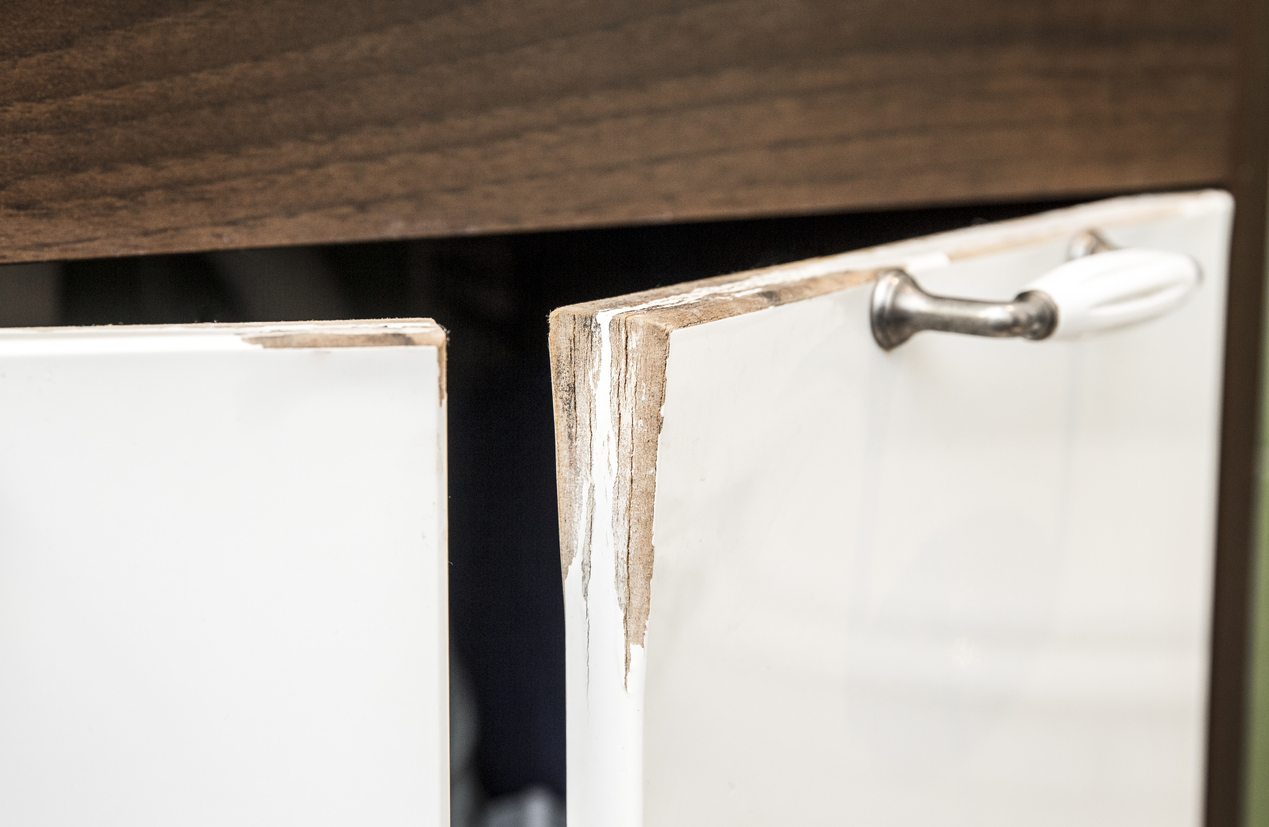
Early Warning Signs
Catch problems early to avoid costly replacements:
– Loose hinges that won’t stay tight
– Slight swelling at cabinet bases or edges
– Doors not closing flush or drawers misaligning
– Visible gaps at joints or corners
– Musty smell near cabinet bases
These signs mean moisture or wear is taking a toll. Tighten hardware, inspect for leaks, and reseal edges immediately.
Moderate Damage
When issues progress, repairs become more involved:
– Peeling laminate or bubbling surfaces
– Screw holes that spin freely
– Sagging shelves even when lightly loaded
– Warped cabinet boxes pulling away from walls
At this stage, minor repairs like filling stripped holes with epoxy or replacing damaged drawer fronts may buy time. But if multiple cabinets show these signs, full replacement may be more cost-effective.
Severe Failure
Don’t ignore these red flags:
– Crumbling or soft particle board that breaks apart when touched
– Doors falling off due to failed hinge attachments
– Extensive mold growth inside cabinet boxes
– Structural collapse of shelves or base units
Once particle board reaches this point, replacement is necessary. Attempting repairs is unsafe and unlikely to last.
How to Extend Cabinet Lifespan
Seal All Exposed Edges
The single most effective step is to seal every cut edge. Use waterproof edge banding or apply clear polyurethane, epoxy, or silicone caulk to all exposed areas, especially around sinks, cooktops, and cutouts. Reapply sealant every 1 to 2 years or when you notice wear.
Control Humidity and Ventilation
Keep indoor humidity between 30% and 50%. Use exhaust fans in kitchens and bathrooms. Install dehumidifiers in basements or humid climates. Ensure airflow behind cabinets and don’t push them flush against walls in damp areas.
Upgrade to Soft-Close Hardware
Replace cheap hinges and slides with soft-close models. They reduce slamming by 80 to 90 percent, dramatically lowering stress on joints and screw holes. The upgrade pays for itself in extended cabinet life and quieter operation.
Avoid Water Exposure
Wipe up spills immediately. Use trays or mats under sinks and appliances. Never let standing water sit on countertops or cabinet tops. Check plumbing connections twice a year for leaks.
Perform Annual Maintenance
Once a year:
– Inspect all edges and joints
– Tighten loose hardware
– Reseal worn areas
– Test shelf stability
– Clean hinges and slides
This routine can add 3 to 5 years to your cabinets’ life.
When to Replace vs. Repair
Repair If:
- Only one or two cabinets are damaged
- No structural compromise, such as solid boards or no mold
- Damage is minor, like loose screws or small swelling
- You plan to stay less than 5 years
Cost-effective fixes include epoxy-filled screw holes, new edge banding, and hardware upgrades.
Replace If:
- Multiple cabinets show swelling or delamination
- Mold is present
- Base units are pulling away from walls
- Repair cost exceeds 50% of replacement
In high-traffic or moisture-prone areas, full replacement with plywood or solid wood is often the smarter long-term investment.
Particle Board vs. Alternatives

Plywood: 20 to 30+ Years
Plywood resists moisture and holds screws far better. It’s 2 to 3 times more durable than particle board and can be repaired or refinished. Ideal for long-term homes. Upfront cost is higher, but cost per year is often lower over time.
MDF: 15 to 25 Years
MDF is denser and smoother than particle board, making it better for painted finishes. It handles moisture slightly better when sealed but still swells when wet. Best for upper cabinets or low-moisture areas.
Solid Wood: 30 to 50+ Years
Solid wood is the gold standard. Solid wood cabinets last decades, can be sanded and refinished, and add resale value. Most expensive upfront but unbeatable for longevity and aesthetics.
Who Should Use Particle Board Cabinets?
Choose Particle Board If:
- You’re on a tight budget
- You’ll move within 5 to 7 years
- The space is low-moisture, like an office or utility room
- It’s a rental property or temporary setup
- You’re using RTA or IKEA-style cabinets
Avoid Particle Board If:
- You plan to stay 10+ years
- The kitchen or bathroom sees heavy daily use
- You live in a high-humidity climate
- You want easy repairs or refinishing
- Resale value is a priority
Final Verdict on Particle Board Cabinet Lifespan
In real-world terms, most particle board cabinets last 5 to 10 years. Budget models in harsh conditions may fail in 3 to 5 years, while high-quality, well-maintained units in dry areas can reach 15 years. But unlike solid wood or plywood, particle board doesn’t age gracefully. Once it starts failing, it deteriorates fast.
For short-term needs or cost-sensitive projects, particle board is a practical choice. But for lasting value, durability, and peace of mind, plywood or solid wood is worth the investment. If you do choose particle board, seal the edges, control moisture, and upgrade the hardware. These steps alone can double its lifespan.
Frequently Asked Questions About Particle Board Cabinets
Can particle board cabinets be refaced or repainted?
Refacing is possible if the cabinet boxes are structurally sound. Surface preparation is critical for paint adhesion, and melamine surfaces require special primers. Refacing costs approximately 50 to 70 percent of replacement cost. Structural damage negates the value of refacing.
How can I tell if my particle board cabinets are failing?
Look for swelling at edges, especially near water sources. Check for loose hardware that won’t tighten. Test for soft spots by pressing on panels. Observe door and drawer alignment changes. Watch for visible warping or bowing.
Is it worth repairing particle board cabinets?
Minor repairs like screw holes or small swelling are worthwhile. Moderate damage may be repairable if caught early. Extensive water damage or structural failure warrants replacement. Consider repair cost relative to replacement cost using the 50 percent threshold.
What is the best way to protect particle board from moisture?
Seal all exposed edges with waterproof sealant. Use silicone caulk at seams and joints. Install moisture barriers under sinks and near appliances. Maintain consistent indoor humidity levels between 30 and 50 percent. Wipe spills immediately and ensure proper ventilation.
How does particle board compare to IKEA-style cabinet construction?
Many RTA cabinets use particle board cores. IKEA and similar brands use particle board with melamine or foil finishes. Quality varies significantly between budget and premium RTA lines. Some RTA manufacturers now offer plywood or MDF upgrades. Construction quality and hardware often matter more than core material.
Key Takeaways for Maximizing Particle Board Cabinet Lifespan
Particle board cabinets can last anywhere from 3 to 20 years depending on quality, conditions, and care. The realistic expectation for most installations is 5 to 10 years. Understanding the material’s limitations, implementing preventive measures, and recognizing early failure signs are essential for maximizing service life.
If you already have particle board cabinets, start with the annual maintenance routine outlined above. Seal exposed edges, control humidity, and upgrade to soft-close hardware. If you’re shopping for new cabinets, weigh the cost-per-year value of plywood against the upfront savings of particle board. For permanent homes and long-term installations, investing in plywood or solid wood cabinets is generally recommended for superior durability, repairability, and overall value.


