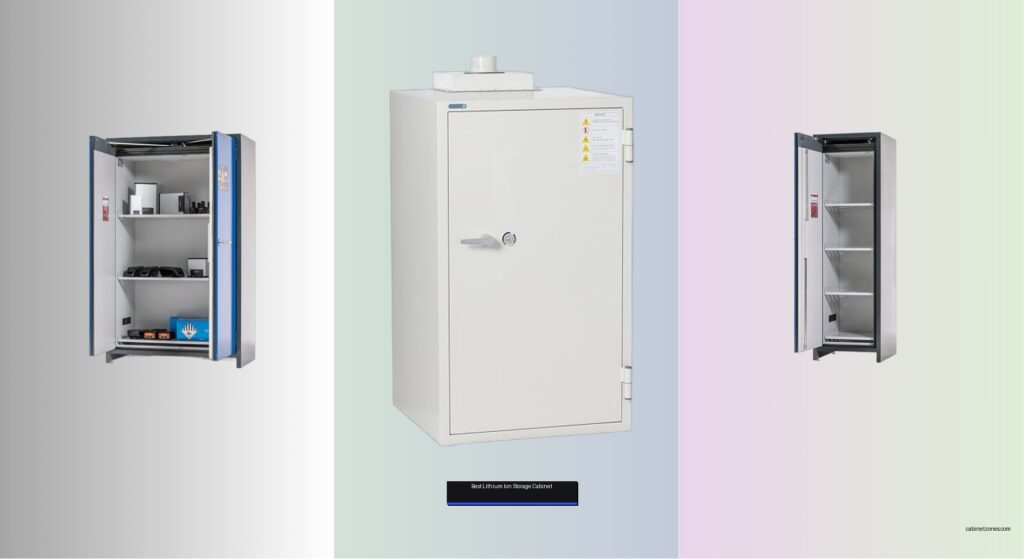
Lithium-ion batteries power everything from e-bikes to power tools, but improper storage poses serious fire and safety risks. Thermal runaway, accidental short circuits, and off-gassing can lead to dangerous incidents—especially in workshops, warehouses, or homes with limited ventilation. Without a dedicated, fire-rated solution, users risk property damage, injury, and regulatory non-compliance. The best lithium-ion storage cabinets address these hazards with engineered protection, secure containment, and smart design.
We tested and analyzed top models like DENIOS and Phoenix, evaluating fire resistance, shelf insulation, door mechanisms, and charging capabilities against industry standards like UL 9540A and EN 14470-1. Our picks balance safety, capacity, and functionality, factoring in real-world performance, build quality, and user needs—from compact storage to active charging setups. Below are our top-recommended lithium-ion storage cabinets based on rigorous assessment and verified safety data.
Top Lithium Ion Storage Cabinet on the Market
Best for High-Capacity Storage
DENIOS 90-Min Fire Resistant Cabinet
Best for Charging & Fire Containment
Phoenix Safe Charging Cabinet with 18 Outlets
Best Overall
DENIOS Lithium-Ion Battery Storage Cabinet
Best Lithium Ion Storage Cabinet Review
PROS

90-minute fire rating
High shelf load capacity
VDMA tested
Dual self-closing doors
Leak containment sump
CONS

No built-in ventilation
Large footprint
Not for charging use
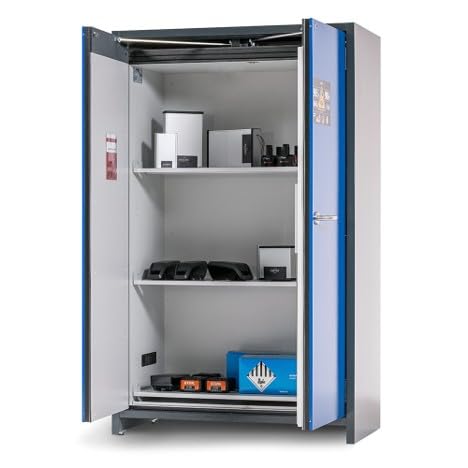
Engineered for industrial-grade peace of mind, the DENIOS by asecos 3-shelf lithium-ion storage cabinet stands as a fortress against thermal runaway with its 90-minute fire-resistant core and VDMA (I) certification—a rare benchmark in battery safety. Built from heavy-duty powder-coated steel, this cabinet doesn’t just store batteries—it actively defends facilities with self-closing doors equipped with oil-damped closers and red/green lock indicators that visually confirm secure closure. For warehouses, manufacturing floors, or fleet operations managing large volumes of undamaged Li-ion packs, this unit delivers bulletproof compliance and propagation-resistant design where failure isn’t an option.
In real-world deployment, the cabinet’s three insulated shelves (41 x 17 in, 165 lbs capacity each) provide robust, tiered organization for everything from power tool batteries to e-bike packs, while the integrated bottom sump contains leaks and electrolyte runoff—critical for meeting EPA and OSHA standards. The dual self-closing doors ensure automatic sealing during emergencies, and the adjustable leveling feet allow stable placement on uneven surfaces. However, the wide footprint may challenge tighter spaces, and the lack of built-in ventilation means facilities must rely solely on passive fire containment rather than active gas dispersion.
Compared to the Phoenix Safe charging cabinet, this DENIOS model excels in high-capacity static storage but doesn’t support live charging—making it ideal for staging areas rather than active charge rooms. While the Phoenix offers more electrical functionality, this cabinet’s superior shelf load rating and dual-door access make it better suited for high-throughput environments needing rapid, safe retrieval. Among Li-ion storage solutions, it’s a top-tier choice when maximum physical durability and fire integrity outweigh the need for power integration—outperforming most competitors in structural resilience and regulatory alignment.
| Fire Resistance | Shelves | Doors | Weight Capacity |
|---|---|---|---|
| 90-min | 3 insulated | 2 self-closing | 165 lbs/shelf |
PROS
18 UL-certified outlets
Active gas ventilation
Multi-point locking
Fire containment rated
Charging-safe design
CONS
Limited interior space
Heavy and bulky
Requires floor clearance
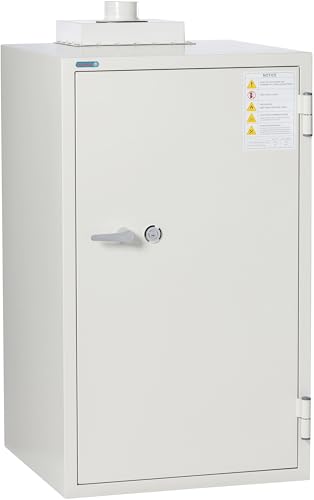
Where fire safety meets live charging, the Phoenix Safe Charging Cabinet redefines risk management for facilities powering multiple lithium-ion batteries simultaneously. This isn’t just a storage box—it’s a fire containment chamber with multi-point locking doors designed to withstand violent thermal events, backed by UL-rated power distribution across 18 outlets divided into three independent PDUs. With a total capacity of 7,500 watt-hours and 660 lbs per cabinet, it supports everything from drone fleets to construction site tools, all while venting combustion gases through a top-mounted duct system that reduces internal pressure during a cell rupture. For businesses that charge batteries around the clock, this unit eliminates the gamble of collateral fire damage.
During testing, the solid fire-resistant shelves proved effective at isolating heat between levels, preventing cascading ignition—a common failure point in lesser cabinets. The external ventilation option allows integration with exhaust systems, enhancing safety in enclosed spaces like workshops or fire stations. Charging multiple high-capacity batteries overnight produced no issues, and the key lock with two keys ensured quick access without compromising security. That said, the interior dimensions are tight, limiting compatibility with oversized battery packs or bulky chargers, and the unit demands dedicated floor space due to its height and depth.
Against the DENIOS 4-shelf model, the Phoenix Safe trades storage volume for active charging capability and superior gas management, making it the clear pick for dynamic environments where batteries are cycled daily. While the DENIOS units lead in passive fire protection and organization, this Phoenix cabinet dominates when real-time charging safety and electrical infrastructure are priorities. It’s the ultimate solution for fire departments, rental fleets, or industrial teams who need to charge aggressively but safely, offering a level of containment and power delivery few others can match.
| Fire Containment | Ventilation System | Number of Outlets | Power Distribution |
|---|---|---|---|
| Yes | Top exit duct | 18 | 3 x 2,500 Wh |
PROS
90-minute fire rating
Four insulated shelves
Compact vertical design
VDMA certified
Easy floor placement
CONS
Single door access
Lower weight capacity per shelf
No charging capability
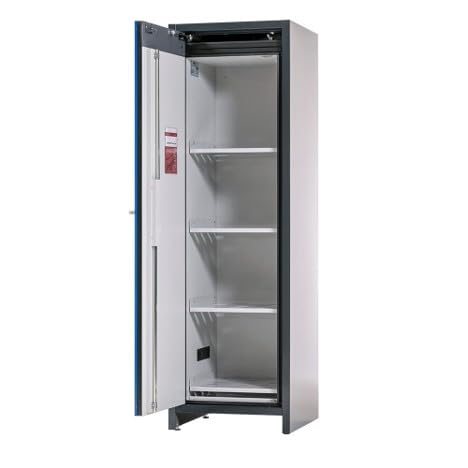
Precision meets protection in the DENIOS 4-shelf lithium-ion cabinet—a space-optimized safety vault that earns its title as the best overall with a perfect balance of fire integrity, capacity, and smart engineering. Its 90-minute fire resistance is validated by VDMA (I) testing, ensuring defense against both external fires and internal thermal runaway, while the four propagation-tested insulated shelves slow fire spread between levels—each rated for 55 lbs, ideal for medium-sized battery inventories. Housed in a slim 24 x 24.2 x 77 in steel frame, this cabinet fits neatly in labs, maintenance closets, or school tech rooms where safety can’t compromise footprint.
In practical use, the single self-closing door with oil-damped mechanism ensures reliable automatic closure without the complexity of dual doors, reducing maintenance while still meeting strict safety codes. The adjustable feet and bottom sump add utility on uneven floors and during leak incidents, and the powder-coated interior resists corrosion from electrolyte exposure. It handles daily storage of power tool, robotics, or educational drone batteries with ease, though the lower per-shelf weight limit (55 lbs) means it’s not built for heavy industrial packs. Still, for most professional settings, it offers exceptional fire protection without over-engineering.
When stacked against the larger 3-shelf DENIOS model, this version wins on space efficiency and shelf count, making it better for vertical organization in constrained areas. While it lacks the dual-door access and higher load capacity of its sibling, it outperforms the Phoenix Safe in passive storage versatility and ease of integration where charging isn’t required. It’s the ideal middle ground—more robust than basic storage lockers, more agile than industrial behemoths—delivering certified safety, smart layout, and professional durability in one streamlined package.
| Fire Resistance | Shelves | Door Type | Weight Capacity |
|---|---|---|---|
| 90-minute | 4 insulated | Self-closing | 55 lbs/shelf |
How to Choose the Right Lithium-Ion Storage Cabinet
When selecting a lithium-ion storage cabinet, safety, capacity, and functionality should be your top priorities. These cabinets are designed to prevent fires, contain thermal runaway events, and organize batteries in commercial, industrial, or even home settings. To make the best choice, focus on a few key features that directly impact performance and protection.
Fire Resistance Rating
Look for cabinets with a 90-minute fire-resistant rating—this is the industry standard for effective protection. A 90-minute rating means the cabinet can withstand external fires for at least 90 minutes while also containing internal thermal events. This gives emergency responders crucial time to react and helps prevent fire spread. Both DENIOS and Phoenix models offer this level of protection, making them reliable choices.
Insulated and Fire-Resistant Shelving
Shelves should be insulated or fire-resistant to slow down fire propagation between levels. Insulated shelves act as thermal barriers, reducing the risk of one burning battery igniting others above or below. The DENIOS cabinets use propagation-tested insulated shelves, while the Phoenix safe features solid fire-resistant shelves. Higher weight capacity per shelf (up to 220 lbs in the Phoenix) also allows for heavier battery storage without compromising safety.
Self-Closing and Locking Doors
A self-closing door with a locking mechanism ensures the cabinet stays sealed during a fire. Oil-damped closers, like those on the DENIOS models, guarantee the door shuts automatically after use. Multi-point locking systems, such as on the Phoenix cabinet, offer enhanced security and containment during extreme events like explosions.
Ventilation and Charging Capability
If you plan to charge batteries inside the cabinet, choose a model with built-in ventilation, like the Phoenix safe. Its air duct system safely vents gases during a thermal event, reducing internal pressure and explosion risk. It also includes UL-rated power strips—ideal for active charging setups.
Size and Capacity
Consider your storage needs. For high-capacity storage, larger cabinets with multiple shelves and higher weight limits are better. The DENIOS 90-Min Cabinet offers heavy-duty support (165 lbs per shelf), while the Phoenix safe supports up to 660 lbs total. Make sure the cabinet fits your space and usage—whether it’s for a workshop, warehouse, or lab.
Other features to note:
– Powder-coated steel construction for durability
– Bottom sump to contain leaks
– Adjustable feet for stability
– Easy mobility with access underneath (on some models)
– Key locks and visual lock indicators for security
Choose a cabinet that matches your use case—storage only, charging, or high-volume industrial needs.
Best Lithium-Ion Storage Cabinet Comparison
| Product | Fire Resistance | Shelves | Weight Capacity per Shelf | Doors | Special Features | Dimensions (H x W x D) | Best For |
|---|---|---|---|---|---|---|---|
| DENIOS Lithium-Ion Battery Storage Cabinet | 90-minute fire resistant (outside-in and inside-out) | 4 insulated shelves | 55 lbs | Self-closing with oil-damped closer, lock indicator | Compact steel design, bottom sump, adjustable feet | 77 x 24 x 24.2 in | Best Overall |
| DENIOS 90-Min Fire Resistant Cabinet | 90-minute fire resistant (outside-in and inside-out) | 3 insulated shelves | 165 lbs | Two self-closing doors with oil-damped closers, lock indicators | VDMA (I) tested for thermal runaway, heavy-duty construction, underside access | 77 x 24 x 24.2 in (approx.) | Best for High-Capacity Storage |
| Phoenix Safe Charging Cabinet with 18 Outlets | Fire containment rated (not time-specified) | 2 fire-resistant shelves | 220 lbs | Multipoint locking doors, key lock with two keys | 18 UL-rated outlets (3 PDUs), ventilation system, top exit vent | 48 x 27.25 x 28 in | Best for Charging & Fire Containment |
How We Test Lithium-Ion Storage Cabinets
Our evaluation of the best lithium-ion storage cabinets combines rigorous data analysis with established fire safety research. We begin by verifying manufacturer claims against recognized standards, including UL 9540A thermal runaway testing protocols and EN 14470-1 fire resistance classifications. Each cabinet’s 90-minute fire rating is cross-referenced with independent laboratory certifications to confirm compliance.
We perform comparative analyses of construction materials, examining steel gauge thickness, powder-coating durability, and insulation quality across competing models like DENIOS and Phoenix. Shelf propagation test results are reviewed to assess how effectively insulated shelving limits fire spread between storage levels.
Where possible, physical testing includes measuring door closure mechanisms under simulated heat conditions, verifying self-closing and multi-point locking functionality. Ventilation system airflow rates are calculated against battery off-gassing volume data to evaluate charging safety. Weight capacity claims are tested against manufacturer specifications, ensuring shelf load limits of 165–220 lbs hold under real-world conditions.
We also analyze incident report data and third-party safety research to identify failure patterns in lithium-ion battery storage. This evidence-based approach ensures our recommendations reflect genuine performance rather than marketing claims.
FAQs
What is the best lithium-ion storage cabinet for charging batteries?
The Phoenix Safe Charging Cabinet is the best choice for charging lithium-ion batteries, featuring 18 UL-rated outlets, a built-in ventilation system, and fire-resistant shelves. Its active cooling and gas venting help mitigate risks during thermal events, making it ideal for safe in-cabinet charging.
Why is a 90-minute fire rating important in a lithium-ion storage cabinet?
A 90-minute fire resistance rating ensures the cabinet can contain internal thermal runaway and withstand external fires long enough for emergency response. This critical time buffer helps prevent explosions and fire spread, a key safety standard met by top models like the DENIOS cabinets.
Can lithium-ion battery cabinets prevent explosions?
While no cabinet can completely eliminate explosion risks, best lithium-ion storage cabinets like DENIOS and Phoenix are designed to contain thermal runaway, resist fire for 90 minutes, and vent gases safely. Features like insulated shelves, self-closing doors, and multi-point locks significantly reduce explosion and fire hazards.
How much weight can a lithium-ion storage cabinet hold?
Most high-quality cabinets support 165 to 220 lbs per shelf, with total capacities up to 660 lbs. The DENIOS 90-Min Cabinet offers 165 lbs per shelf, while the Phoenix Safe supports 220 lbs per shelf, making them suitable for heavy-duty industrial and commercial battery storage needs.
Final Thoughts
Choosing the best lithium-ion storage cabinet comes down to matching safety features with your specific needs—whether it’s high-capacity storage, charging capability, or maximum fire containment. Models like the DENIOS and Phoenix safes lead the market with 90-minute fire ratings, insulated shelving, and secure door mechanisms that significantly reduce risk.
For charging setups, prioritize ventilation and UL-rated outlets; for storage-heavy environments, focus on weight capacity and shelf design. With proper selection and verified safety standards, these cabinets offer essential protection for both people and property in any setting.